
History Visits
Teaching (Crafts and Pastimes)
With myself as host, in full period costume, I will work with you to help you learn a historic technique or skill. Audience participation is greatly encouraged.
You will get to use replica and reproduction period tools and equipment; access to historical references, sources, and images; and you can take your project home - finished or not!
A session lasts approximately 45-60 minutes and costs £45 plus 45 pence per mile travel fee. Contact me here to book.
Choose from the following topics:
-
Viking Dress Decoration (make replica Viking cord, using just your fingers, or a 'twining bone', and learn about other period methods of fibre manipulation) - using 4 to 12 elements
-
Historic Flax Process - Anglo-Saxon to Medieval (learn how it grows, through how it was processed, to producing flax fiber for spinning) needs a 3m square floor space

-
Useful Anglo-Saxon Cordage (make a replica Anglo-Saxon cord that had a particular use, and learn about other period methods of fibre manipulation) - using 4 to 9 elements
Two women braiding, fresco in the 'Haus zur Kunkel' Constance, Germany, before 1306 (Rosgartenmuseum Konstanz).
Historic Flax Process
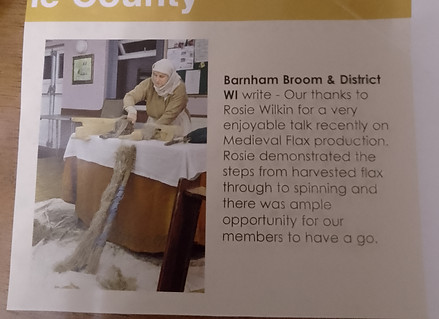
From the Women's Institute magazine. (2022)
See the Day Hire page for more pictures
Cords / Cordage
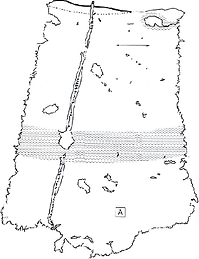

The 10th century Hedeby Harbour 'apron-dress' fragment, showing wear from a belt across the middle and placement of the decorative cord over the dart.
The braid is made in wool of 6 elements coloured red and yellow alternately and measures just 2mm wide. The dress was dyed blue, so this would have been a striking contrast. The Vikings did love their 'bling'!


My table set up for 'Viking Dress Decoration'.


My 'third hand method' of controlling your elements (using your teeth!)

Inset: process of making the 9-element braid that was found binding a collection of small iron objects in an 8th century burial in Orsett, Essex.
Below: cord made by the lovely ladies of at Fincham Women's Institute, Kings Lynn, August 2026.


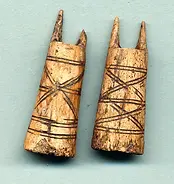

'Lucets' or 'Twining Bones' from 10th century Scandinavia.